1986 – 2026 The Anniversary of the Tethys Research Institute
40 Years of Science and Conservation of Cetaceans in the Mediterranean
On January 31st, 2026, the Tethys Research Institute celebrated forty years of activity dedicated to the research and conservation of marine mammals in the Mediterranean. A milestone that perhaps neither its founders, Giuseppe Notarbartolo di Sciara and Egidio Gavazzi, nor the small group of us young biologists who supported them since the early days, could have imagined at the time.
When it was founded, Tethys seemed a quite “unlikely” project; studying whales and dolphins in the Mediterranean was considered, to say the least, an eccentric idea. Yet the newly established non-profit had a very concrete goal: to lay the foundations for the protection of the marine environment. An intuition that today – at a time of profound environmental and climate crisis – has been fully confirmed by science: large marine animals such as whales are fundamental to the health of the oceans and, consequently, of the entire planet.
Today we know much more. Fin whales, sperm whales, and, in all likelihood, all eight cetacean species that regularly inhabit the Mediterranean are genetically distinct from Atlantic populations. This makes them a unique natural heritage, but also particularly vulnerable. The Mediterranean is one of the most heavily trafficked seas in the world, and these animals are threatened by pollution, habitat loss, declining food resources, ship strikes, underwater noise and accidental entanglement in fishing gear.
Unfortunately, this is also true for the main hotspot for whales and dolphins in the northwestern Mediterranean: the Pelagos Sanctuary, established through an agreement between Italy, France, and the Principality of Monaco. The idea of a transnational stretch of sea dedicated to cetaceans – entirely innovative at the time – was first proposed by Tethys itself. In 2002, thanks also to the push from several major environmental organizations, it became a reality: the world’s first protected area for cetaceans beyond national jurisdictions.
In other words, much remains to be done. In terms of spatial protection, additional “pieces of the puzzle” have recently been added: the designation of the northwestern Mediterranean as a Particularly Sensitive Sea Area (PSSA); a small but important protected area for the Mediterranean monk seal in Greece; and, worldwide, the identification of numerous Important Marine Mammal Areas (IMMAs).
As for research, thanks to two long-term programs – the Cetacean Sanctuary Research project and the Ionian Dolphin Project, launched respectively in the Ligurian Sea in 1990 and in the Ionian Sea of Greece in 1991 – Tethys now holds the longest datasets of their kind in the Mediterranean. These projects also boast record-breaking figures: the total distance monitored amounts to more than seven and a half times the circumference of the Earth, and days spent at sea exceed 5,700. But what matters most are the results, also produced by numerous other targeted projects, and made public through more than 800 publications, including scientific journal articles, conference presentations, books, and popular articles.
This information does not remain locked away in scientists’ drawers. One of Tethys’s long-standing goals has always been to share research objectives and results with the wider public, with the ultimate aim of raising awareness of the need to protect our seas. Outreach goes beyond texts, photos, videos, and social media posts – it can also take the form of direct experience. To date, over 7,500 people have joined the Institute’s biologists at sea as “citizen scientists,” actively contributing to research and to concrete action for the protection of marine mammals and their environment.
On behalf of the Tethys staff, thank you to all participants, collaborators, and to everyone who has supported us over the years! You give us the energy to continue along this journey.
Maddalena Jahoda
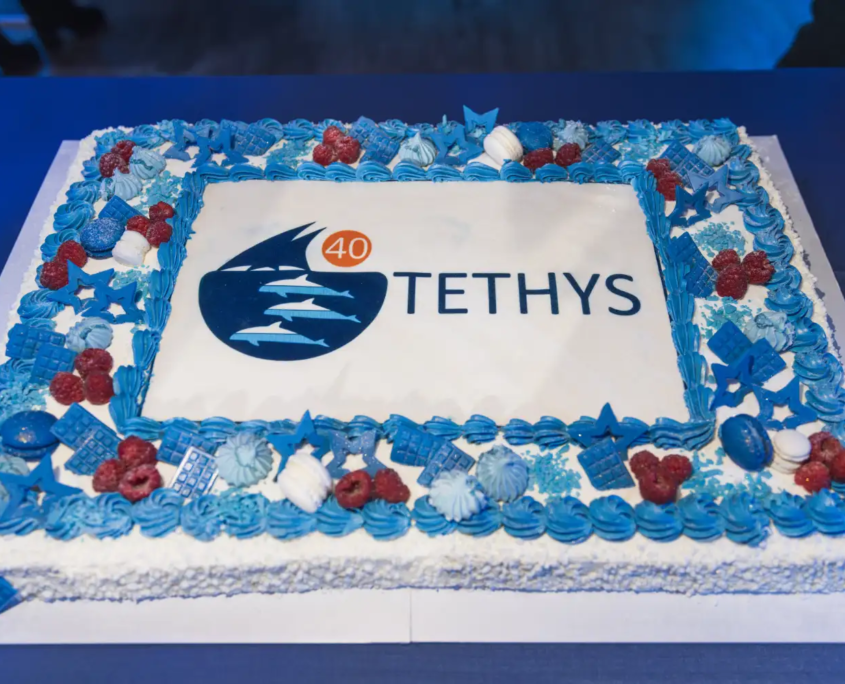
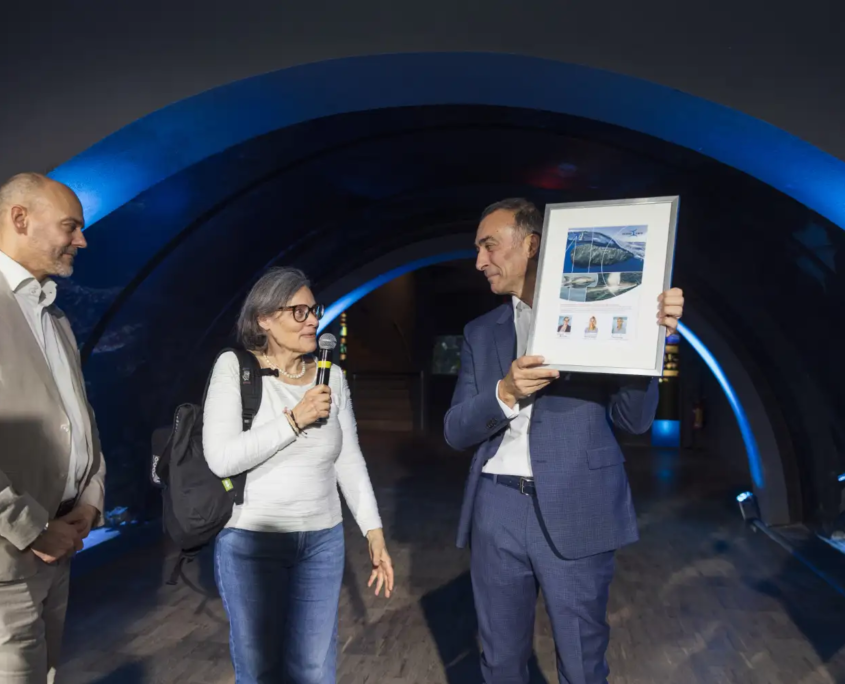
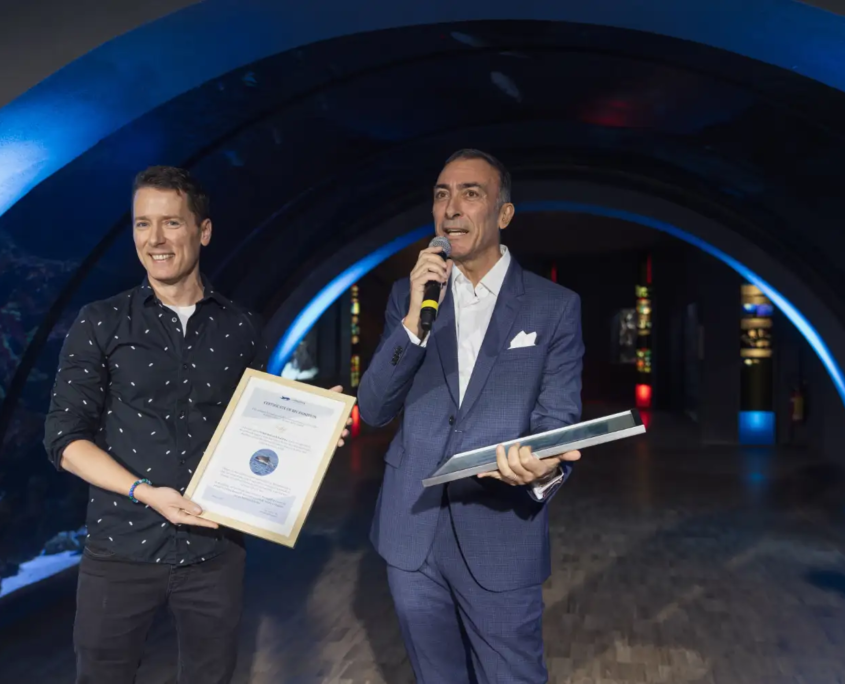
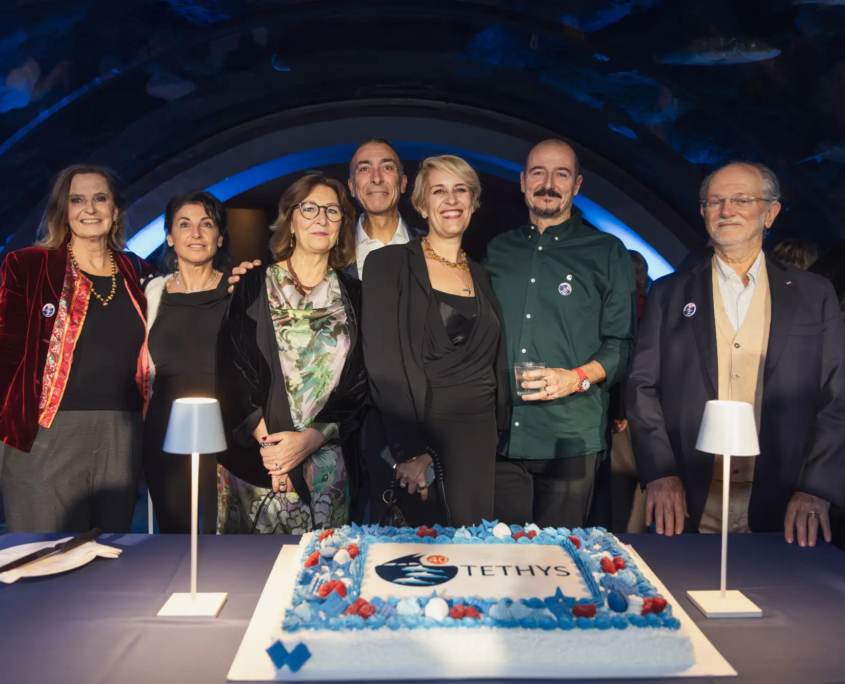
The Institute’s staff cut the 40th anniversary cake in the splendid setting of Milan’s Civic Aquarium. Here is what the President and Honorary President had to say on the occasion.
Tonight we are celebrating 40 years of Tethys. 40 years of science, commitment, intuition, sacrifice and passion for the Mediterranean Sea and the conservation of its marine mammals. But above all, forty years of people.
It’s so incredible to be here tonight in these amazing premises, the Civic Aquarium of Milan, built in 1906, for the International Expo, one of the best examples of Liberty style. We have the privilege of having our offices here at the Aquarium and I want to extend my deepest gratitude to its Director, and to its former Director, here with us tonight, who allowed this important achievement.
When Tethys was founded in 1986, the Mediterranean was still widely considered a marginal sea for large marine mammals. Systematic research was a rare thing, protection almost non-existent, and the idea that cetaceans could guide conservation policies was far from obvious. What Tethys did from the very beginning was something revolutionary for its time: long-term, independent, science-based research, carried out at sea, year after year.
Over four decades, Tethys has helped demonstrate that the Mediterranean is not an empty sea, but a complex, living ecosystem, home to resident populations of whales and dolphins that deserve attention, respect, and protection. Many of the concepts that today seem self-evident were once controversial: critical habitats, negative cumulative impacts, the importance of marine spatial planning, Important Marine Mammal Areas (IMMAs). Tethys people were there early, often alone, insisting on evidence and consistency.
Tethys has always believed in science with a purpose. Not science locked in drawers, but science that informs conservation, management, and policy. From the original idea of the creation of the Pelagos Sanctuary to international agreements, from shipping derived impacts, such as noise and collisions, to climate change, Tethys has consistently worked at the interface between research and decision-making.
And this is not always comfortable. Science that matters often raises difficult questions. It challenges habits, economic interests, and political shortcuts. Tethys has never aimed to be popular. It has aimed to be credible, scientifically sound and robust.
Another defining feature of Tethys has been the long-term vision. In a world increasingly dominated by short projects and quick results, Tethys has insisted on continuity. Some of our long-term projects have datasets that span decades. And today, those datasets are more valuable than ever, because they allow us to understand trends, resilience, and changes in a Mediterranean Sea under unprecedented pressures.
But an anniversary is not only about looking back. The Mediterranean today faces challenges that were unimaginable 40 years ago: accelerating global warming, increasing levels of maritime traffic, cumulative pressures, geopolitical instability, and a growing gap between environmental goals and real implementation. In this context, the role of independent scientific organizations like Tethys is more necessary than ever.
The future of Tethys will depend on our ability to remain scientifically rigorous, attract and train new generations of researchers, maintain independence, and continue to act as a bridge between knowledge and action.
If there is one lesson from these 40 years, it is that persistence matters. Real conservation does not happen in a few years. It happens over decades, through patience, credibility, and the refusal to give up when progress seems slow.
Tonight is also a celebration of community. Tethys is not just an institute – it is a network of passionate people who believe that the Mediterranean Sea is worth understanding and protecting, not because it is easy, but because it is necessary.
I would like to thank all of you who have been part of this journey, whether for one season or for a lifetime. Your contribution is at the base of Tethys’ legacy.
Simone Panigada, President
Forty years is a long time. It may not seem so – most of us expect to live at least twice as long – but it is still a long time. To truly grasp it, we need to remember what things were like back then.
There was no internet. No email, either. Cameras were analog. GPS did not exist. Research methods were fairly rudimentary. We did not even know for certain which cetacean species regularly inhabited the Mediterranean.
Few people believed that whales truly belonged to this sea. Public fascination with dolphins was only just beginning. Less than twenty years had passed since governments were still paying fishermen to kill them. On the global stage, forty years ago the moratorium on commercial whaling was adopted – a ban that is still in force today.
We knew how to collect data and publish scientific papers, but we did not know how to run an organization. We wanted knowledge to serve conservation, but we had no clear idea of how to make that happen.
This was forty years ago, when we began. When my friend Egidio Gavazzi and I went to the notary to establish Tethys. Egidio is no longer with us, but this evening Barbara and Antonella, his daughters, are here.
Looking at Tethys today, the change is undeniable. We can be proud of what we have built together and of all that has been accomplished. I am deeply grateful to everyone who made this possible – and there are many. First and foremost Simone Panigada, who has played a key role in strengthening Tethys’s international standing in recent years.
Yet one question remains that we must ask ourselves: how much of this progress has truly improved the lives of marine mammals in the Mediterranean? To some extent, improvements have occurred. Awareness has grown. Respect has increased. Some parts of the sea are now safer. I am thinking of the disappearance of driftnets from the Pelagos Sanctuary, and of the return of sperm whales to waters they had previously abandoned.
But it is not enough. Life in the Mediterranean remains difficult for marine mammals. And it is not just a matter of survival. Of course, we are right to be concerned about their future, even though no species is currently on the brink of disappearing from our waters. Even the Mediterranean monk seal, once critically endangered, is now cautiously reclaiming ground.
But what does it mean to survive if it means living in constant fear of getting caught in a net, of ending up in a ship’s propellers, if their stomachs are filled with plastic, if the sea becomes deafening?
Survival alone, especially for sentient beings, is not enough. We must care about the quality of life of these animals, not just their survival.
It’s more difficult, but I believe this must become the new frontier of our society and of our commitment.
Giuseppe Notarbartolo di Sciara, Founder and honorary President