
Pelagos Sanctuary, blue carbon sink
Bluescape project investigates the “added” value of the large marine protected area for cetaceans in the northwestern Mediterranean in terms of combating climate change
How much is the Pelagos Sanctuary “worth” in terms of “ecosystem services,” or in other words, how much benefit does the Planet, and therefore we, derive from the presence of this extraordinary hotspot in the Mediterranean?
This is the question that the BLUESCAPE project, which started in March 2024 and is funded by the Pelagos Initiative, aims to answer.
As we know, oceans can sequester carbon, the substance that forms the basis of the main greenhouse gas, carbon dioxide, which, when emitted in excess by human activities, causes climate change and serious global climate imbalances. When marine ecosystems sequester this substance, it is called “blue carbon.” This also applies to the Mediterranean, and especially to one of its richest regions in the northwestern part, the Pelagos Sanctuary. This vast transnational marine protected area, the first of its kind, was established through a tripartite agreement between Italy, France, and the Principality of Monaco, initially suggested by the Tethys Institute.
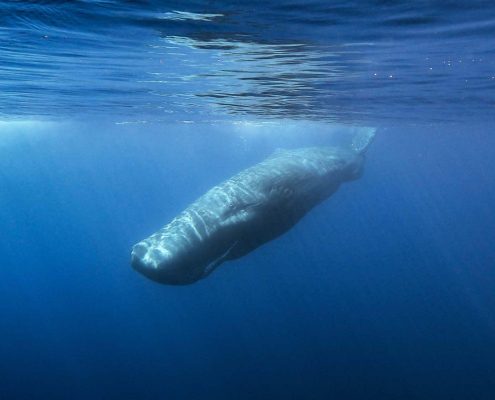
The Sanctuary was created primarily to protect cetaceans; as is well known, all eight Mediterranean species frequent it, including two “giants,” the fin whale and the sperm whale. Marine mammals play a crucial role in the fight against excess carbon in various ways. Firstly, since they frequently feed at great depths and defecate at the surface, cetaceans are valuable providers of fertilizer for marine plants, especially phytoplankton, which, like forests on land, removes CO₂ and provides oxygen.
But there’s more: like all living beings, the tissues of cetaceans are partly composed of carbon; larger species like fin whales or sperm whales, or more numerous ones like striped dolphins, store more of it. In the Mediterranean, another highly efficient “carbon sequesterer” exists – the Posidonia oceanica, a marine plant endemic to our seas.
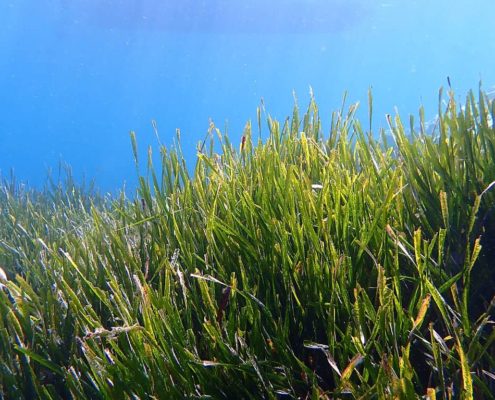
@Frédéric Ducarme – Creative Commons Attribution-Share Alike 4.0 International license
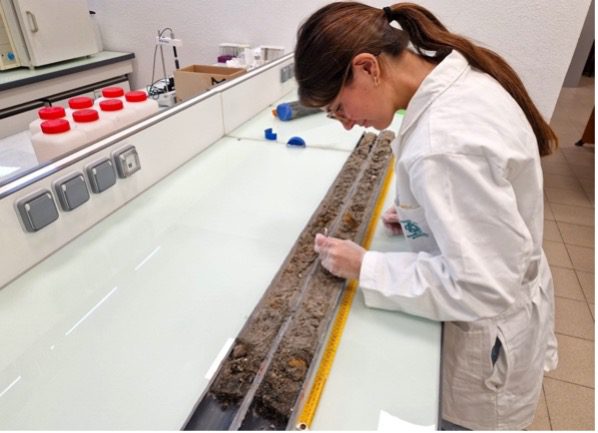
The Bluescape project, led by DICA (Department of Civil and Environmental Engineering) at the Polytechnic University of Milan, in partnership with the Tethys Institute and the Stella Mare Institute of the University of Corsica, aims to quantify the Pelagos Sanctuary’s carbon sequestration capacity. Why the Sanctuary? Not only because it hosts a significant quantity and variety of whales and dolphins, but also because it includes both coastal areas (Liguria, Tuscany, Sardinia, the French Riviera, and northern Corsica) and a large part of the pelagic zone, i.e., the open sea.
Funded for three years by the Prince Albert II of Monaco Foundation, the World Wide Fund for Nature (WWF), the International Union for Conservation of Nature (IUCN), and the Network of Marine Protected Areas in the Mediterranean (MedPAN), the organizations that created the Pelagos Initiative, Bluescape focuses on several key elements:
- The cetaceans of the Pelagos Sanctuary, which Tethys has been systematically monitoring for over 35 years, including their relative abundance. How much “blue carbon” is represented by the gigantic fin whales and sperm whales? And by smaller species like dolphins and Cuvier’s beaked whales?
- Their feces, collected both at sea and from stranded animals (in the latter case, by CREDIMA, the National Reference Center for Diagnostic Investigations on Stranded Marine Mammals): how much do they contribute to providing iron and mineral salts, and thus fertilizing the waters?
- The Posidonia oceanica: how much carbon can it sequester in its underwater meadows?
By combining these data and supplementing them with environmental surveys, measured both on-site and by satellite, it will be possible to quantify and map the blue carbon flows in the Sanctuary. This will provide yet another reason to protect it.