
A sperm whale group spotted in the Pelagos Sanctuary: a rare encounter that renews concerns over ship strikes
An unforgettable experience for participants in our research cruises in the Ligurian Sea (NW Mediterranean), alongside the sighting of a curious young sperm whale that approached the boat. Yet this remarkable encounter also highlights the threats posed by maritime traffic.
“My legs were shaking!” recalls Andrea Savi from Piacenza (Italy), one of the citizen science participants aboard Pelagos on the 11th June. “It was an incredible experience, far beyond anything I had hoped for. And hearing the whales’ vocalizations through the onboard hydrophone made the encounter truly magical.”
An unusual sighting marked the beginning of the new research season of the Cetacean Sanctuary Research project in the Pelagos Sanctuary. Departing from Portosole in Sanremo, researchers and participants sighted a family group of sperm whales (Physeter macrocephalus) consisting of a calf, a juvenile, and an adult, presumed to be the mother, accompanied by another individual displaying highly unusual behaviour rarely observed in this region.
In Tethys’ study area, sperm whales are sighted regularly, but they are typically adult or subadult males encountered alone. Family groups composed of females and calves are generally found farther south, outside the Sanctuary that was established specifically to protect marine mammals.
Although this is not the first time a social group has been observed in the area, the sighting was unexpected. Most previous encounters occurred later in the season, usually from August onwards.
The group included an adult estimated to be about 9 metres long, while the smallest whale measured approximately 5 metres, suggesting an age of around one year. A third individual was a juvenile, somewhat larger. Photo-identification of the tail flukes revealed a first surprise: the presumed female had already been photographed in October last year. In addition, another juvenile was observed nearby, appearing more independent but likely still associated with the group.
For everyone on board, the encounter was both deeply moving and a valuable reminder of the conservation challenges facing these animals. The presence of young sperm whales within the Pelagos Sanctuary once again draws attention to one of the main threats to Mediterranean sperm whales: collisions with vessels.
Adult males undertake very deep dives and spend relatively little time at the surface breathing. Calves and juveniles, however, remain at the surface for much longer periods, making them particularly vulnerable to potentially fatal ship strikes.
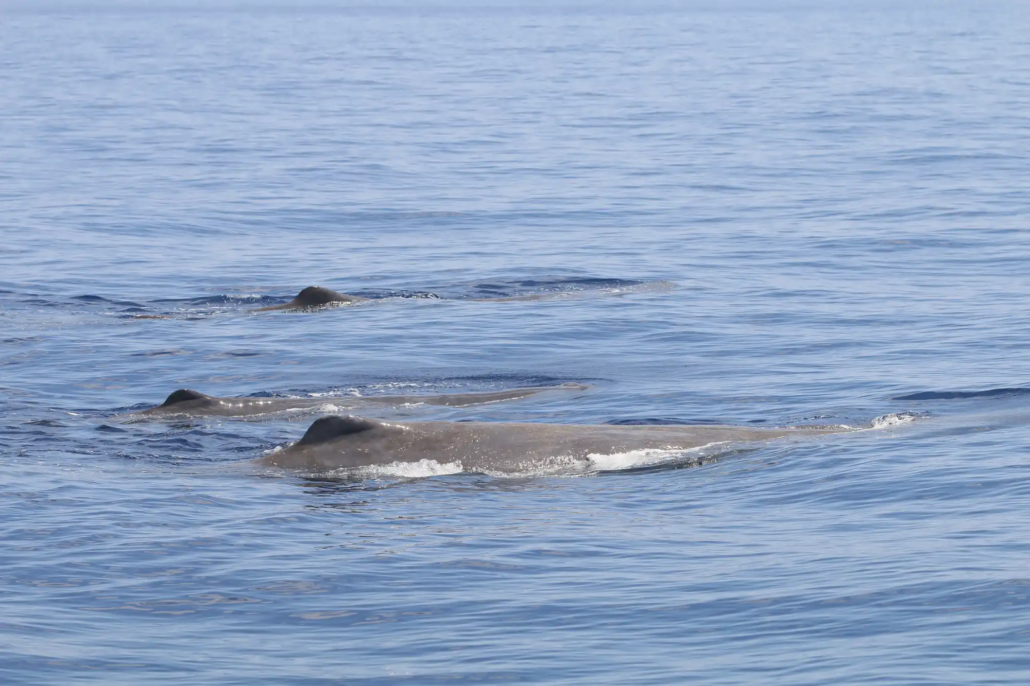
“Since 2017, sightings of such groups in the Pelagos Sanctuary appear to have increased,” explains Maddalena Jahoda, researcher and science outreach manager at Tethys. “Over the past six years they have become relatively regular. The reasons remain unclear and are one of the questions researchers are trying to answer. While this trend offers exciting new opportunities for study, it is also a source of concern because these animals are spending time in an area with intense maritime traffic.”
“We have already seen evidence of this issue during our very first outings of the season,” adds Caterina Lanfredi, who this year has taken over as coordinator of the Cetcaean Sanctuary Research project. “Early in the season we encountered ‘Freddy’ and ‘Fralu’, two sperm whales that we have monitored for 17 and 9 years respectively, and we immediately recognized thanks to the distinctive scars on their bodies.”
The sighting that most captivated participants during the same cruise, however, involved a young sperm whale that voluntarily approached the research vessel, swimming around it and repeatedly lifting its head as if observing the people on board. Such behaviour is extremely rare and has only been documented a handful of times in this study area, most recently in 2023.
Each week, around ten participants join Tethys researchers in monitoring cetaceans within the Pelagos Sanctuary. No previous experience is required. Participants learn field research techniques, contribute directly to data collection, and gain a deeper understanding of the importance of marine conservation.