
Photos tell stories of ‘Monet’ and ‘Carli’
Monet
Why is it important to identify a specific fin whale? Or to recognize that this sperm whale is the same one spotted last year? Distinguishing individual animals is not an end in itself but a powerful tool in the hands of researchers. It allows us not only to learn the stories of individuals but also, for example, to track their movements.
Photo-identification is one of the somewhat unusual skills that experts teach participants on board the research boat “Pelagos” of Flash Vela d’Altura. As is well known, we are not alone in our fieldwork but are accompanied each week by a new group of about ten participants from the public (“citizen scientists”) who assist us as “marine biologist” helpers.
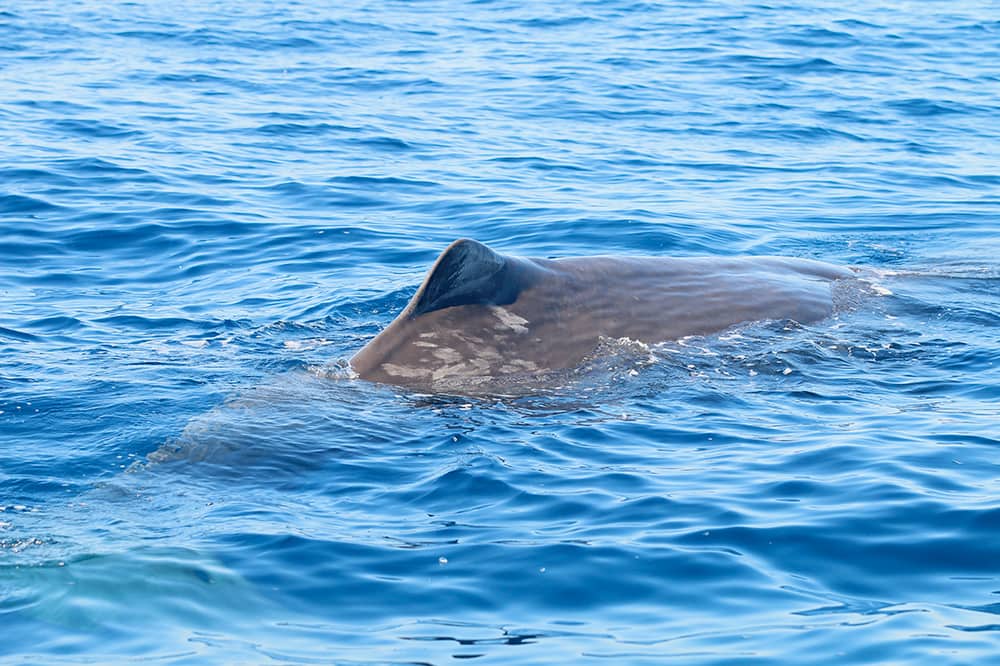
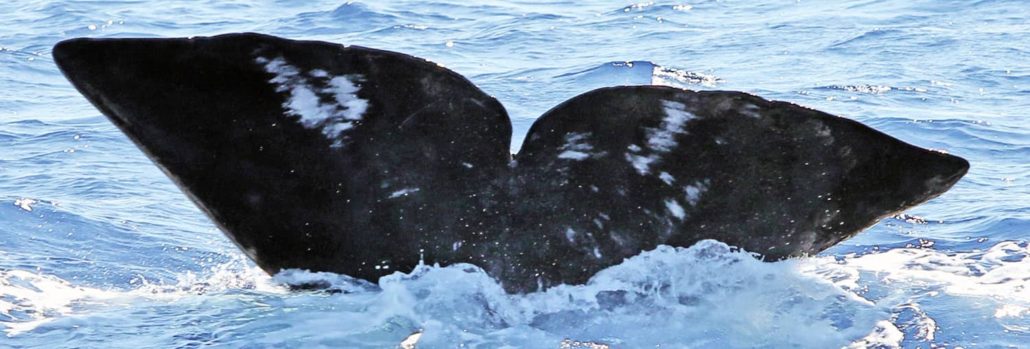
Two fin whales (Balaenoptera physalus) can be distinguished by the notches on their dorsal fins, just as two sperm whales (Physeter macrocephalus), the other large cetacean species in our seas, have differently shaped tails. This led to a surprise during one of the first outings this summer. The first sperm whale of the season was “Monet,” a young male named after the famous painter who lived for a time in Bordighera; the whitish spots on his body resemble the brushstrokes of impressionists.
Another old acquaintance of ours was recently spotted off the coast of Barcelona, Spain. This is the sperm whale “Carli,” named in honor of the renowned olive oil producer, who has been an important sponsor of the Cetacean Sanctuary Research project for years. We have known Carli since 2017, and from the video by our colleague Eduard Degollada, it was easy to recognize him: a confirmation of the extensive movements these cetaceans are capable of. This knowledge is crucial for the protection of Mediterranean populations, made possible thanks to the simple yet powerful technique of photo-identification—a technique for which high-resolution images are essential. These images are produced by Tethys experts thanks to the sophisticated equipment sponsored by Canon.
Maddalena Jahoda
Carli