“Stripes”: one more whale injured by a propeller in the Pelagos Sanctuary
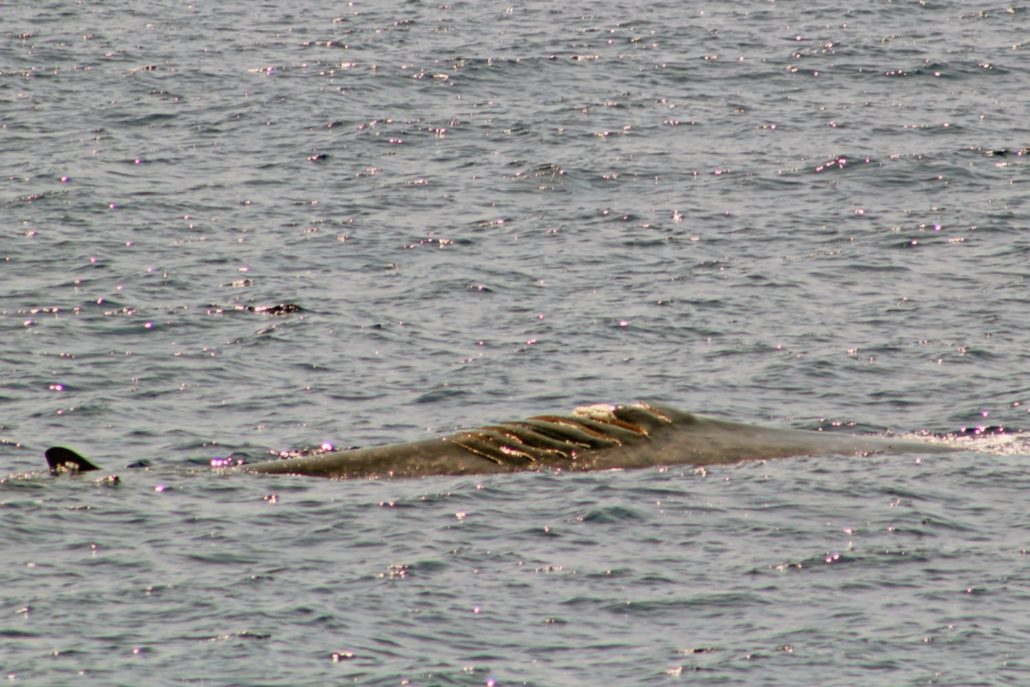
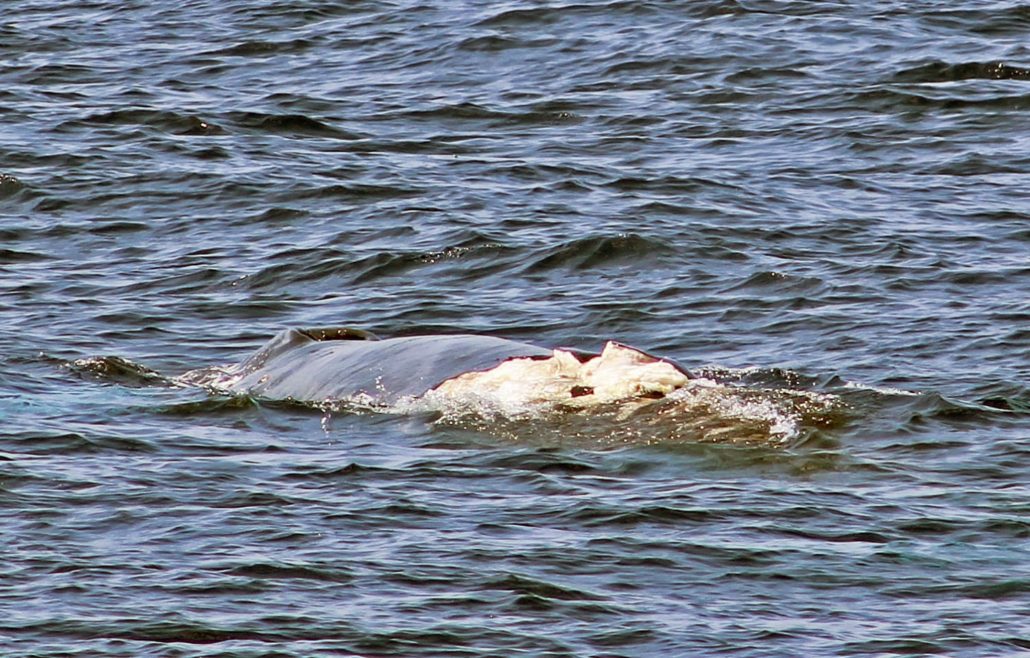
On Wednesday, August 13th, a shocking report reached our research vessel Pelagos, operating in the waters of the western Ligurian coast. The information came from the Corsara, a boat from Golfo Paradiso Whale Watching, that had departed from Andora: they had sighted a fin whale with a series of deep cuts along its back, with large “blobs” of subcutaneous fat protruding from one side. Despite the severe, apparently recent, injury—clearly caused by a collision with a ship propeller—the animal was alive, alternating between periods at the surface and short dives.
Fin whales (Balaenoptera physalus) are one of the iconic marine mammal species in the Mediterranean sea. They are mainly sighted during summer in the Ligurian Sea and around Corsica, where they feed on krill. This area is central to our Cetacean Sanctuary Research project and is part of the Pelagos Sanctuary, established specifically to protect Mediterranean whales and dolphins. Unfortunately, it also coincides with one of the busiest maritime traffic areas in the world.
Injuries like these are, sadly, not isolated cases. Both sperm whales and fin whales are often sighted with propeller scars. We know and gave names to individuals such as “Propeller,” “Mezzacoda” (“Half Tail”) or “Codamozza” (“Chopped Tail”). Regarding the latter, a recent article in the scientific journal Ecology and Evolution (1) detailed the tragic story of a fin whale whose tail was completely amputated, eventually dying after a year of suffering. These are just some of the cases we know about; it is believed that many accidents, including fatal ones, go unnoticed.
We have affectionately named this “new” injured fin whale Stripes, recalling the shape of the horrific wounds inflicted by humans, with the hope of resighting her healed, one day.
While this hope is heartfelt, it does not resolve the serious issue of ship collisions with large whales, which, according to an extensive research (2), could possibly lead to a decline in fin whale populations in the Mediterranean.
The risk increases with vessel speed, particularly above 10 knots. In some parts of the world, ferry routes have been relocated to reduce the risk of whale collisions. In the Pelagos Sanctuary, however, this would be hard to put into practice because fin whales are widely dispersed offshore, often unpredictably. Closer to shore, sperm whales—the other large cetacean species in Mediterranean waters—are dangerously close to cargo routes, as demonstrated by another study coordinated by Tethys and funded by the Permanent Secretariat of the Pelagos Agreement (3).
While awaiting technological solutions, such as those being developed by the European Life SeaDetect project, in which Tethys participates, the only practical measure at present is to reduce vessel speeds in critical areas. This approach recently gained a legal framework with the recognition by the International Maritime Organization (IMO) of the northwestern Mediterranean as a Particularly Sensitive Sea Area (PSSA). We can only hope that effective measures to prevent ship-cetacean collisions will soon be implemented at least in this area.
Maddalena Jahoda
Read more: On a collision course: whales and sperm whales threatened by large vessels :
We thank Federica Cammarano and Franco Chiaschetti of Golfo Paradiso Whale Watching for the photos and report, as well as the italian Coast Guards, ready to respond to any sightings of the animal. However, we strongly recommend that anyone who spots the whale keep their distance to avoid causing further stress.
- Jahoda, M., Zanardelli, M., Dhermain, F., Alessi, J., Armonio, F., Ballardini, M., Barcelo, A., Calogero, G., Fontanesi, E., Frantzis, A., Menniti, M.A., Monaco, C., Obadia, C., Pellegrino, G., Raffa, A., Tardy, C., Verga, A., Violi, B., Panigada, S. (2025). Codamozza‐Fluker: The Compelling Case of a Flukeless Fin Whale Traveling Throughout the Mediterranean Sea and the Need for Basin‐Wide Conservation Efforts. Ecology and Evolution, 15(5). https://doi.org/10.1002/ece3.71313
- Sèbe, M., David, L., Dhermain, F., Gourguet, S., Madon, B., Ody, D., Panigada, S., Peltier, H., Pendleton, L. 2023 Estimating the Impact of Ship Strikes on the Mediterranean Fin Whale Subpopulation. Ocean & Coastal Management, vol. 237, Apr. 2023, p. 106485, https://doi.org/10.1016/j.ocecoaman.2023.106485.
- Panigada, S., Azzellino, A., Cubayanes, H., Folegot, T., Fretwell, P., Jacob, T., Lanfredi, C., Leaper, R., Ody, D., Ratel, M. 2020. Proposal to develop and evaluate mitigation strategies to reduce the risk of ship strikes to fin and sperm whales in the Pelagos Sanctuary – Final Report. Pelagos Secretariat – Convention No. 2018-04. 67 pp.