
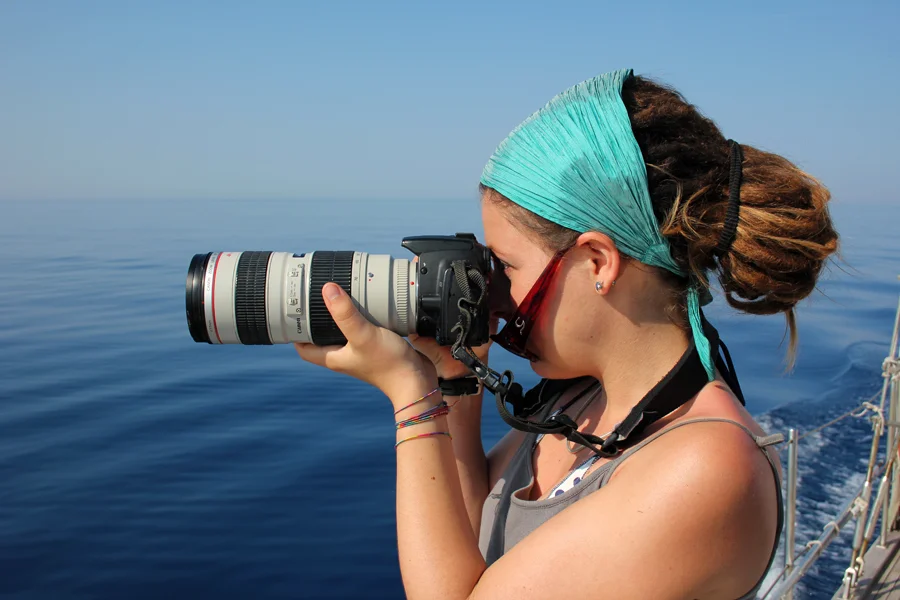
Mid-summer report from the Pelagos Sanctuary: over 130 cetacean sightings
In the first two months of the research season, the Cetacean Sanctuary Research project has already recorded six of the eight cetacean species regularly found in the Ligurian Sea: fin whales, sperm whales, Cuvier’s beaked whales and dolphins with calves. However, a high number of sightings in the study area does not necessarily reflect a general favourable conservation status for either cetaceans or the Mediterranean Sea itself.
Summer is still far from over, but the first two months of fieldwork have already revealed an exceptionally rewarding research season. Since May, Tethys researchers and citizen science participants have been back on board the research vessel Pelagos for the 38th season of the Cetacean Sanctuary Research project, collecting valuable data on the cetaceans of the Pelagos Sanctuary.
So far, the team has recorded more than 130 cetacean sightings, documenting six of the eight species regularly occurring in the area. These results have also been favoured by exceptionally good sea and weather conditions, allowing many productive hours of fieldwork.
Yet numbers tell only part of the story. What has made this first part of the season truly remarkable are the encounters themselves: large aggregations of fin whales, frequent sperm whale sightings, Cuvier’s beaked whales, Risso’s dolphins, and several calves swimming alongside their mothers, providing valuable insights into how different cetacean species use this important Mediterranean habitat.
Among the season’s highlights has been the unusually high number of fin whale sightings compared with previous years. The world’s second-largest animal was observed in remarkable concentrations within a relatively small area, between 20 and 30 nautical miles offshore, most likely attracted by an abundant supply of krill.
Sperm whale encounters have also increased significantly, with 30 sightings recorded so far. Researchers can identify individual whales from the unique shape of their flukes and other natural markings. Alongside several whales already included in the long-term photo-identification catalogue, new individuals have also been documented, including females with calves and groups of younger animals, an especially noteworthy finding since this part of the Sanctuary is generally frequented mainly by adult and subadult males.
More sightings mean not necessarily more whales…
These are certainly encouraging findings, but a high number of sightings does not necessarily indicate larger cetacean populations or an improvement in their conservation status. We know that Mediterranean cetaceans continue to face numerous human-induced threats, including ship strikes, entanglement, underwater noise and pollution. A higher frequency of encounters may simply reflect changes in the animals’ distribution, with a greater concentration in certain areas for reasons that are not yet fully understood.
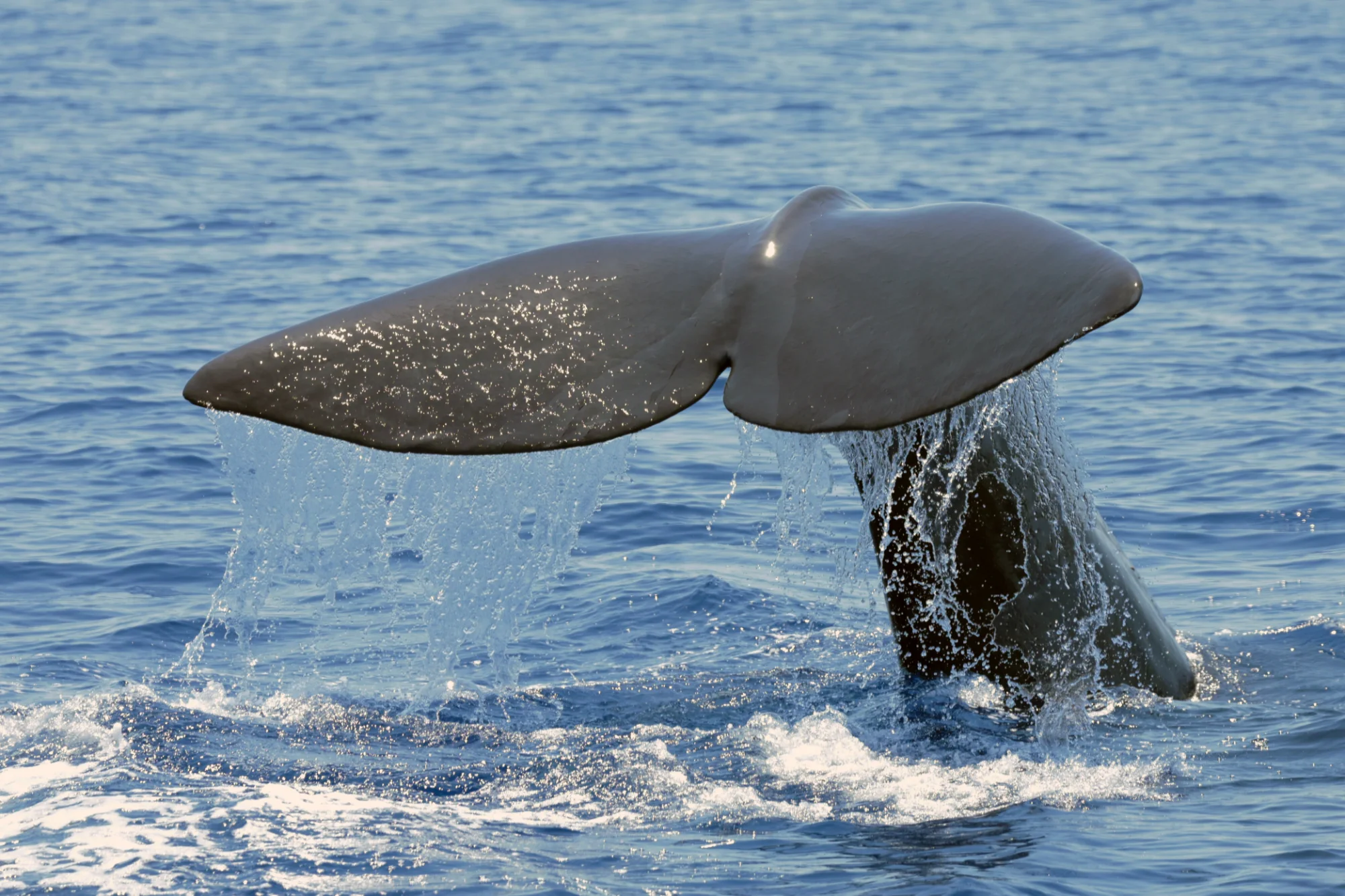
The sperm whale named “CANON”
Sighting number 100: the sperm whale named Canon
For Tethys researchers and citizen science participants aboard Pelagos, operated by Flash Vela d’Altura, the season’s 100th sighting is always a memorable milestone. This year it was marked by a nearly 13-metre-long male sperm whale “adopted” by Canon, the brand which has supported Tethys’ research activities for more than ten years. This latest encounter brings to three the number of sightings of this individual recorded so far this season.
The surprises did not end there. Particularly noteworthy was the sighting of Cuvier’s beaked whales, a species usually concentrated in the deep submarine canyons off Savona and Genoa and less frequently observed in the far western Ligurian Sea. Among them was a female accompanied by her calf.
Dolphins also provided some memorable moments. Risso’s dolphins have become less common in the Tethys study area over recent years, making this season’s first sighting especially valuable: two females travelling with their newborn calves. Both of them still showed distinct fetal folds along their bodies, indicating that they had been born only a few weeks earlier.
Researchers also recorded numerous sightings of bottlenose dolphins, the coastal species also monitored in the Imperia area by the association Delfini del Ponente, many of them accompanied by calves. As usual, striped dolphins, the most abundant cetacean species in the Mediterranean, were the most frequently encountered of all.
The high number of sightings and the widespread presence of calves across all the species observed so far make this an exceptional start to the season and highlight the outstanding ecological value of the area.
The code of conduct for boaters
At the same time, researchers remain concerned about the increase in recreational boat traffic during the summer months, which raises the risk of disturbance, particularly for mothers with young calves. For this reason, it is essential to follow a few simple rules when encountering cetaceans:
- approach only from behind or from the side, never head-on;
- maintain a minimum distance of 100 metres;
- if the animals voluntarily approach the boat, place the engine in neutral;
- never separate members of the same group.
Monitoring in the north-western sector of the Pelagos Sanctuary will continue until October, as part of a long-term research programme that has been providing essential data for the study and conservation of Mediterranean cetaceans for almost four decades.
Maddalena Jahoda
Portosole Sanremo has been supporting research and conservation efforts in the marine environment by providing moorings for Tethys’s vessels since 1988.
For over a decade, Canon has supported Tethys by providing professional photographic and video equipment.