
Sailing Across a Wounded Sea
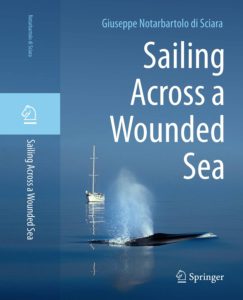 “Seeing the Mediterranean’s progressive degradation at the hands of humans, I felt a surge of rebellion against this squandering of natural values, and wished to raise awareness of the existence of these marine natural treasures and the risk of losing them”: this is how Giuseppe Notarbartolo di Sciara, founder and current vice-president of Tethys, describes the impulse that led him to write his new book ‘Sailing across a wounded sea’, published by Springer Nature.
After having coexisted with a diversity of marine animals throughout their history, humans have broken the balance in recent decades, and the survival of countless marine creatures is now increasingly uncertain in the Mediterranean Sea. However, unlike in classical tragedies, real-life entities are not necessarily doomed by their fate, and there must be hope to turn the tide in nature’s favour. Lack of concrete conservation action might be simply due to a lack of awareness: how can we feel sad about a loss if we don’t know what we are losing?
“Sailing Across a Wounded Sea” is the story of an ideal journey around the Mediterranean to meet its non-human inhabitants, consisting of real episodes collected over half a century as the author observed real animals, exchanged views with a variety of contacts, and argued for such views in the policy arena.
In almost four decades, Giuseppe had described small but vibrant populations of Mediterranean fin and sperm whales, along with various species of dolphins, manta rays and the monk seal, hoping that encountering whales, dolphins, seals and rays in their habitat and on their terms will contribute to building up in readers a collective commitment to help secure a future for these species. A future where they are allowed to flourish as they were meant to – had humans never trod so heavily on the sea’s delicate ecological balance and the interwoven natural processes.
Giuseppe Notarbartolo di Sciara has been involved for a lifetime in protecting marine biodiversity in various capacities – as a scientist, civil servant, advocate and sailor. Having studied in California and worked with whales, dolphins and sharks worldwide, he returned to the Mediterranean in 1985, keen on using his acquired tools to discover more about the ancient sea’s natural history.